
SureKits
Understand SureKits, one subject at a time
Short explanations of what matters most when deciding: the instrument cycle, the safety of the tag, how it gets onto the instruments and what can be read.
The instrument cycle, step by step
SureKits follows the instrument through every stage:
In the operating room
With the instruments laid on the reading table, or checked with the collector over a non-metallic table, the count checks every item before surgery. If an instrument goes into the monitored bin, the CME is warned to check for breakage.
At the end of surgery
The scrub nurse or nurse separates what was actually used from what was not, and the count is made with the collector in two steps, one for each group. Instant identification cuts counting time, frees the room sooner and shows what is really used in each surgery.
In decontamination
Instruments are counted again on a reading table and prepared for cleaning according to their type, which adds redundancy to the process.
In assembly and storage
Each instrument's cycle is monitored until it is back in sterile stock. Boxes can be monitored too, and alerts warn when sterilization is about to expire.
SureKits also supports patient safety: it warns about missing instruments in the count.
Safe and easy to adopt
Two questions decide whether a traceability system is adopted: is the tag safe? And how does it get onto the instruments?
A tag that does not come off
Identhis holds a patent on the tag and on the method of applying the tag to the instrument, developed to make sure it does not come off. That matters for patient safety, because a loose tag could become a retained foreign object.
Applied at the hospital itself
The hospital applies the tags on its own premises, without taking any instrument out of the hospital. There is no transport cost and, above all, no surgery is canceled for lack of instruments while the tags are applied.
Patient safety and application inside the hospital: no transport, no canceled surgeries.
Ergonomics and usability: the instrument stays the same
The tag measures 5 mm x 1.8 mm x 1.3 mm. It is very small and sits at a strategic point on each instrument, chosen so it does not interfere with use and delivers maximum reading performance.
Very small
About the size of a grain, the tag barely changes the volume or the weight of the instrument.
Where it does not get in the way
The position is chosen so it does not interfere with grip, movements or use of the instrument in surgery.
Designed for reading
The same point is chosen for the best reading performance, so that the small tag is read with confidence.
No change to the routine
Scrub nurses and surgeons use the instrument as always. For the CME, it becomes identified.
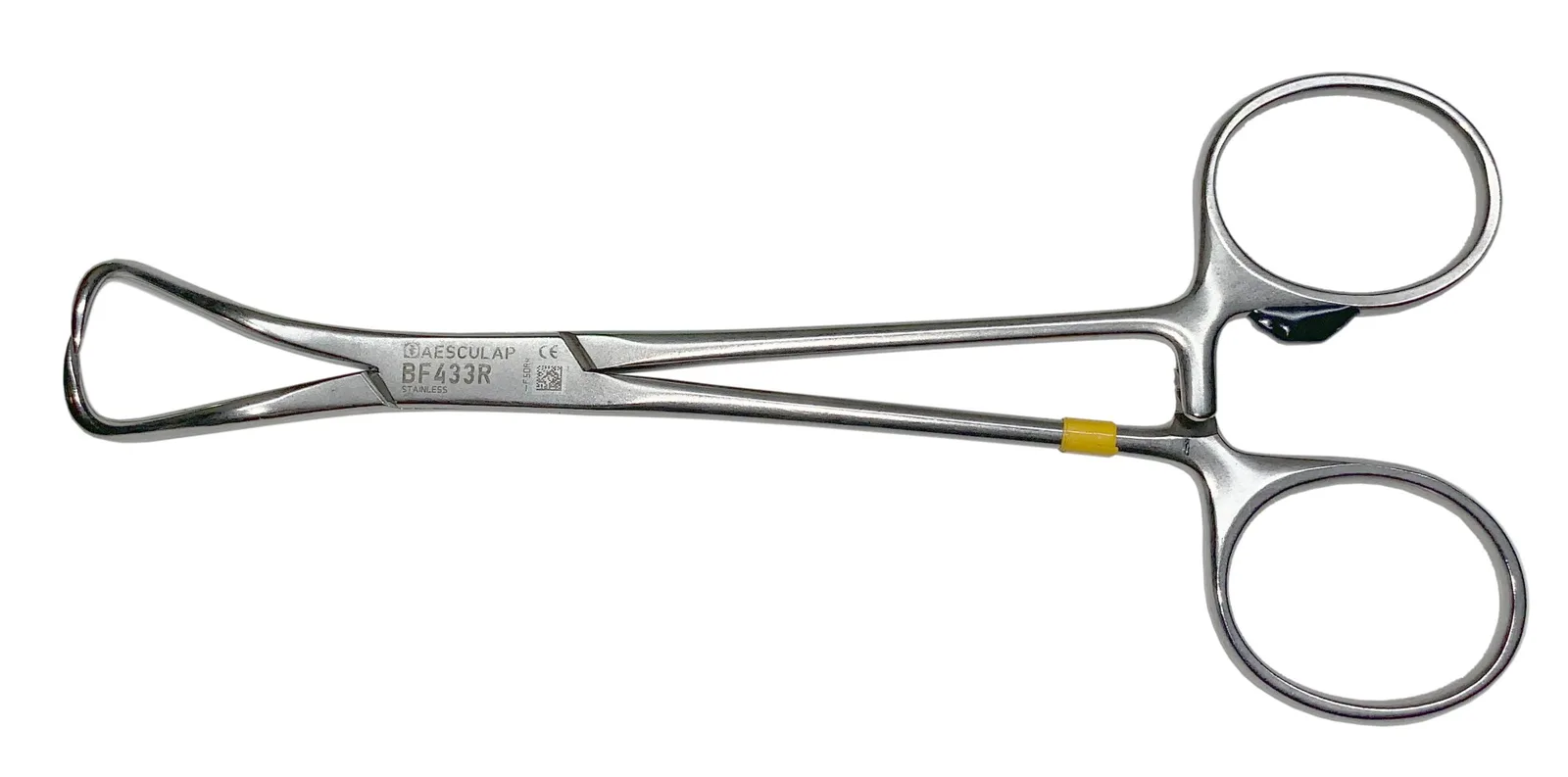
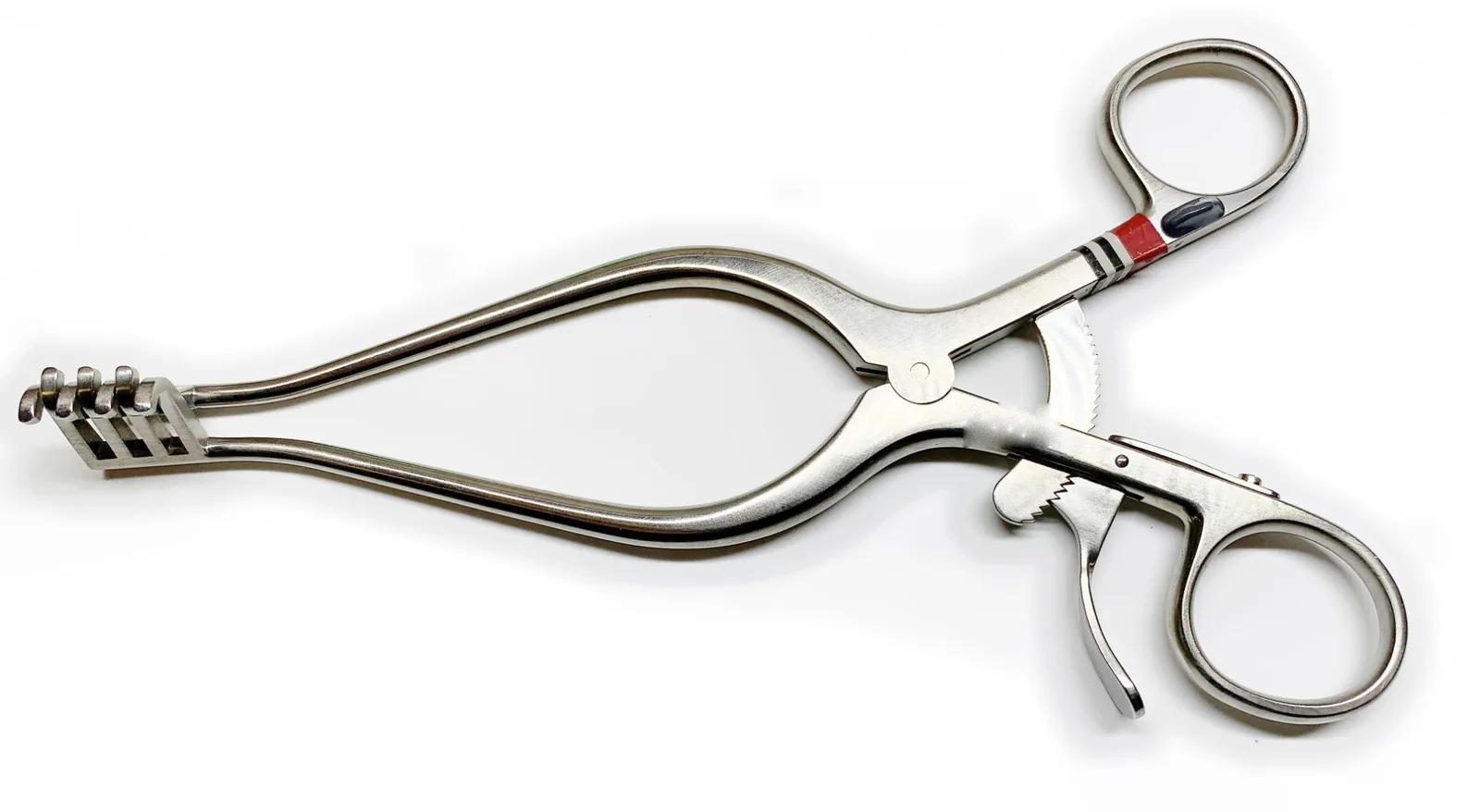
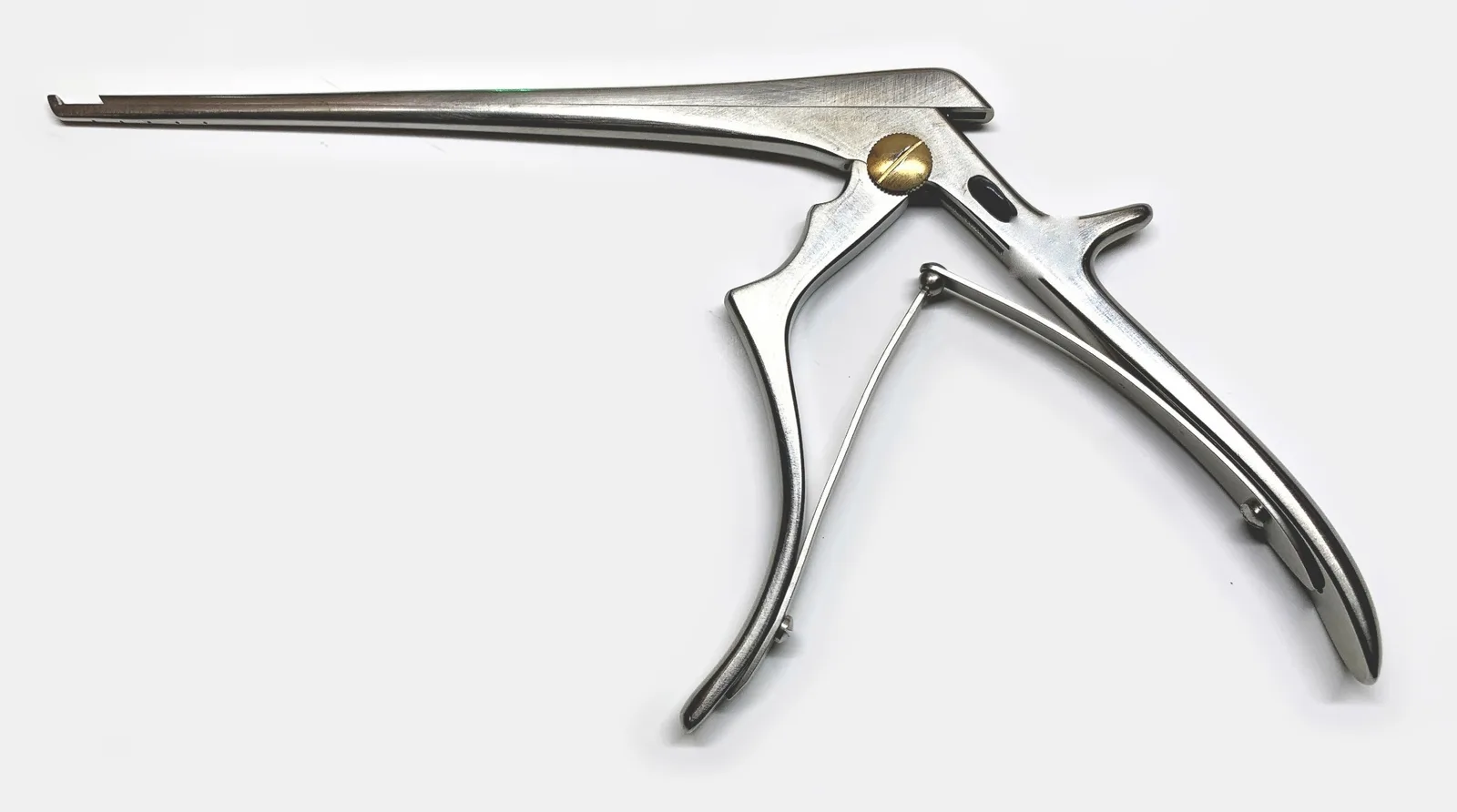
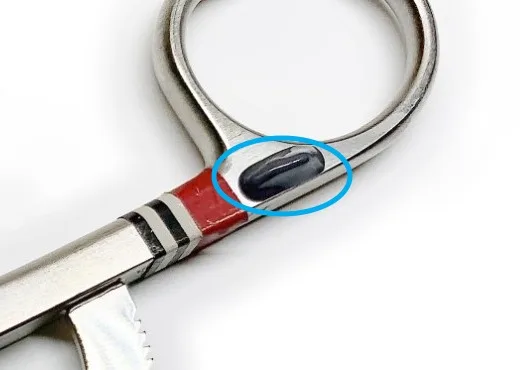
For those who operate, the instrument is the same. For the CME, it becomes identified.
Can 100% of the instruments in the box be read?
No. The metal of the box and of the instruments piled together interferes with radio reading, and saying otherwise would not be honest.
To guarantee reading of 100% of the instruments, they must be laid out on a non-metallic table for counting.
That is what the reading table and the collector used over the table are for: a reliable count is made with the instruments spread on a non-metallic surface. Counting can also be done by passing one or more instruments over the reading table.
How to separate used from unused instruments
The scrub nurse or nurse separates what was actually used from what was not. Then the count is made with the collector in two steps, one for each group.
Over dozens of surgeries, the record shows which instruments in each kit are really used. It is the basis for trimming kits and cutting reprocessing.
See what the literature has already measured about this and run the numbers for your hospital on the evidence page.
Start simple: counting with Identix RFID collectors
The hospital does not have to begin with the complete solution. A good first step is counting: Identix RFID collectors read the tags on instruments laid out on a non-metallic table and check everything at once, without scanning item by item.
Later, the same base grows at the hospital's own pace.
Count with Identix RFID collectors
Fast checking of instruments and boxes, with no manual scanning.
Integrate with the CME software
Readings flow to the sterile processing software the hospital already uses, through integration, with records and history.
Grow when you want
DR-max reading tables, in decontamination and assembly, and the operating-room module come in on the same tag base.
Integrates with the sterile processing software the hospital already uses
SureKits takes care of RFID identification and reading: the tags, the Identix equipment and the checking of items. Process control, batch traceability and audit stay in the sterile processing management software the hospital already uses.
The result is the best of both worlds: the hospital keeps the system its team knows and gets fast, reliable reading, with no typing and no item-by-item scanning.
In one sentence: we make sure we know which instrument is there, and your CME software takes care of the rest.
Identification standards: UDI, GS1 and Datamatrix
Instruments can be identified in several ways, and they complement one another. Understanding each standard helps the hospital choose without rework.
UDI
UDI (Unique Device Identification) gives each medical device a unique identifier, read in a barcode and readable by people. In Brazil, Anvisa regulated it through RDC 591/2021.
GS1
GS1 defines the global identification standards used in healthcare. GS1 DataMatrix carries the product identifier in a 2D code, and EPC is the standard that carries identification into the UHF RFID tag.
Datamatrix
The 2D code marked on the instrument is read with line of sight, one at a time. SureKits coexists with it: the platform accepts Datamatrix, 1D barcode and visual identification, besides RFID.
How SureKits meets them
SureKits tags are RAIN RFID UHF Gen2, with 96 bits of EPC memory and coding in the GS1 EPC standard. The hospital keeps the Datamatrix and UDI the instrument already has and gains the fast reading of RFID, without changing standard. The register accepts several identifiers for the same instrument, such as the tag EPC, the Datamatrix, the UDI and the hospital’s own code. The only requirement is that each identifier is unique to each instrument.
In practice: Datamatrix and UDI remain valid, and RFID adds reading speed.
RFID and Datamatrix: complementary or substitutes?
The Datamatrix marked on the instrument and the RFID tag solve the same problem, identifying each piece, in different ways. Neither is better at everything. The useful question is which one to use in each situation.
Datamatrix is a 2D code in the GS1 standard, and UDI calls for direct marking on reusable devices. It is cheap per piece and comes from the factory on many new instruments. RFID reads without line of sight, in batches, and can be applied to an instrument that never had a marking.
| Criterion | Datamatrix (direct marking) | UHF RFID | Source |
|---|---|---|---|
| How it reads | One instrument at a time, with line of sight and the mark facing the reader | No line of sight, several items at once on the reading table | [3] |
| Time for 41 instruments | 190 s, with an experienced team | 64 s, 66% less, in the same trial | [1] |
| Durability | A laser mark can corrode over cycles: a French 250-cycle study reported loss of legibility in part of the marks. There are also reports of good durability with proper passivation | Tag designed for more than 1500 autoclave cycles at 134 °C | [5] |
| Cost per piece | About €1 to 3.5 per marking, in one French hospital assessment | About €3 to 10 per chip, in the same assessment | [4] |
| Where it is applied | Laser or dot-peen engraving, generally by the manufacturer or a specialized service | At the hospital or company itself, without taking instruments out | [3] |
| Standard | GS1 DataMatrix. UDI requires direct marking on reusable devices in the US | GS1 EPC. It does not replace regulatory marking where required | [2] |
| Instrument with no marking | Only with new engraving | Receives the tag and becomes identified | [3] |
Already has Datamatrix: use both
Datamatrix stays as the manufacturer and UDI identifier. RFID adds fast, batch reading, and the association between the two is recorded once. This is the complementary case.
No marking: RFID is the bridge
Old instruments, rental boxes and sets for OPME implants often have no marking. RFID gives them an identity without outside engraving. In the French assessment cited, RFID was recommended precisely for loaned material. This is the substitute case.
Worn or illegible mark: RFID restores identity
When the engraving wears off, the instrument can no longer be read. The tag keeps it readable without re-marking, and the two coexist.
No obligation to go 100% RFID
SureKits does not require the hospital to put RFID on every instrument. The platform works with both technologies at the same time: Datamatrix stays where it already exists, RFID comes in where there is no marking, and coverage grows little by little, at the pace of the budget and of the CME’s priorities. The same instrument can have several identifiers registered at once, as long as each one is unique.
Datamatrix is the regulatory identity. RFID is the fast reading and the bridge to everything that has no marking yet.
- Datamatrix is cheaper per piece and is already standard at manufacturers. RFID does not remove regulatory marking where it is required.
- The 66% comes from a single-center trial with 41 instruments and eight participants. In another group, without experience, the times were 79.4 s against 212.3 s.
- The durability data for laser marking comes partly from vendors. We found no independent study measuring read rate by number of cycles.
- RFID batch reading requires the instruments laid out on a non-metallic table.
- Kusuda K, Yamashita K, Morishita E, et al. Comparison of Reading Times of RFID-Tagged and Barcode-Engraved Surgical Instruments. J Surg Res. 2024;304:121-125. doi.org/10.1016/j.jss.2024.09.087
- FDA. Unique Device Identification: Direct Marking of Devices. Guidance for Industry and FDA Staff, 2017. www.fda.gov/regulatory-information/search-fda-guidance-documents/unique-device-identification-direct-marking-devices
- GS1 UK. Technologies for marking surgical instruments (direct part marking with GS1 DataMatrix and RFID). www.gs1uk.org/sites/default/files/gs1_uk_hug_technologies_marking_surgical_instruments_docV2_0.pdf
- GS1 France. Traceability of surgical instruments in French hospitals (cost per marking and read rate in the sterilization unit). www.gs1.org/docs/healthcare/20140410%20France%20Frederique%20Fremont.pdf
- Rioblanc et al. Traçabilité individuelle à l’instrument: évolution de la lisibilité des marquages après cycles de stérilisation (resumo). 2023. www.em-consulte.com/article/1607462/tracabilite-individuelle-a-l-instrument-evolution-
- GS1. GS1 DataMatrix: guideline for healthcare. www.gs1.org/sites/default/files/gs1_datamatrix-final_approved.pdf
Counting-time simulator for the room
Enter how many kits of each type go through the room per day and how many instruments they hold. The simulator compares counting time with Datamatrix, with RFID and with both technologies at the same time.
The starting values are examples, to show the calculation. Replace them with your room’s.
- The times per instrument come from specific trials and change with the team, the table and the type of instrument. Replace them with what you measure in your room.
- A Japanese report measured 0.4 s to read each engraved Datamatrix, not counting the time to position the instrument. That is why every value is editable.
- Time gained is not money gained. It only becomes a saving if it becomes fewer paid hours or more capacity. The ROI calculator keeps the two apart.
- RFID batch reading requires the instruments laid out on a non-metallic table.
For companies that rent instruments for implants (OPME)
Those who supply instrument boxes for placing prostheses live with a known problem: the box must arrive complete and on time, come back complete, and nobody wants to argue later about what was missing. The literature records late deliveries that disturb reprocessing and lead to delays and even canceled surgeries, incomplete sets and losses.
When a surgery is canceled, the box has already been processed. In one university hospital, 854 consigned boxes were processed and not used, an estimated waste of R$ 34,340.18. That value is a study average, not a cost per instrument.
Dispatch and return checked
RFID reading checks, instrument by instrument, what left and what came back, with date and time. Supplier and hospital get the same record.
Less argument over missing and damaged items
With each piece identified, it is clear what was delivered, what returned and in what condition. A Brazilian report linked coding of the instruments to fewer complaints about missing material in the boxes.
A complete box before it leaves
Checking at assembly points out what is missing or extra before the box goes to the hospital, instead of finding out in the room.
Where each box is
Readings at dispatch, receipt and return give visibility of the pool of boxes and help plan deliveries in advance.
Real use and a right-sized pool
Knowing what was used and what was not, in each surgery, helps size the number of boxes and trim sets. This needs clinical validation.
Applied at the company, several identifiers
The tag is applied at the company, without sending instruments out. The supplier code, the Datamatrix and the UDI can coexist, as long as each identifier is unique to each instrument.
Limits and care
- An instrument that circulates among several hospitals only brings the full gain if their receiving also reads the tags. That calls for agreement between the parties.
- Batch reading requires the instruments on a non-metallic table, not inside the closed box.
- Technology vendors report large loss reductions with RFID, but with no public methodology. We do not use those numbers. What is published, such as the J&J Supply Chain report, comes from the company itself.
- SureKits identifies and records. Contracts, deadlines and responsibilities stay the same.
For the supplier, the gain is knowing what is in each box and proving what was delivered and what was received.
- Lopes SG, Poveda VB. Model proposal for calculating waste associated with processing consigned surgical instruments. Rev Latino-Am Enfermagem. 2023;31. doi.org/10.1590/1518-8345.6716.4062
- Brazilian field study of 41 reprocessing cycles of loaned sets for total hip arthroplasty. Revista SOBECC. sobecc.emnuvens.com.br/sobecc/article/download/752/715/6174
- Addressing Challenges Associated With Loaner Instrument Sets. AORN Journal, 2026 (abstract). www.unboundmedicine.com/prime/journal/AORN_Journal
- Report on implementing traceability in a Brazilian CME: coding of instruments and fewer complaints about missing material in boxes. CBCENF. inscricoes-cbcenf.cofen.gov.br/anais/19/23581/trabalhoresumodownload
- Johnson & Johnson Supply Chain: UHF RFID with GS1 tags on orthopedic loaner sets (company-reported). RFID Journal. www.rfidjournal.com/?p=187515
What SureKits delivers
Reliable data
Each reading identifies the instrument and the moment, to feed the hospital’s CME software.
Real-time reading
Automatic follow-up of instruments and surgical kits.
History of every piece
Each reading records the instrument and the moment, building the history of every piece.
GS1 EPC standard
Tags with EPC coding in the GS1 standard.
Support for traceability
Provides the identification and reading that support the traceability required by Anvisa RDC 15/2012.
Benefits for the hospital
Real-time traceability
Of all instruments and surgical kits.
Fast counting
With RFID, no manual scanning.
Less rework
RFID checking helps detect missing or extra items during assembly.
Productivity gain
In assembling and checking boxes and kits, RFID reading can raise the number of items handled per employee.
Alerts on deviations and losses
Warns about deviations and losses of instruments along the cycle.
Accurate, automatic records
Electronic records made without typing.
Individual tracing in contamination
If there is contamination, such as by bacteria or prions, each item is traced individually.
RFID compared with other forms of identification
SureKits uses RFID. See how it compares with other ways of identifying instruments.
RFID
Identifies and tracks with no contact and no line of sight, with fast reading.
Datamatrix
2D code engraved on the instrument, read with line of sight.
Chemical or laser marking
Identification engraved on the instrument itself.
Color coding
Visual organization of instruments and kits.
Frequently asked questions
Can the tag come off the instrument?
The tag and the method of applying it to the instrument are patented and were developed so that it does not come off. That reduces the risk of a retained foreign object.
Do I have to send instruments out of the hospital?
No. The hospital applies the tags on its own premises, without taking instruments out. There is no transport cost and no surgery is canceled because of the application.
Can 100% of the instruments in the box be read?
No. To guarantee 100% reading, the instruments must be laid out on a non-metallic table for counting. Counting can also be done by passing one or more instruments over the reading table.
Does the tag get in the way of using the instrument?
No. It measures 5 mm x 1.8 mm x 1.3 mm and sits at a strategic point, chosen so it does not interfere with use and delivers maximum reading performance.
Does SureKits work with UDI and Datamatrix?
Yes. The hospital keeps the Datamatrix and UDI the instrument already has. The platform accepts Datamatrix, 1D barcode and visual identification, and the RFID tags follow the GS1 EPC standard.
Does RFID replace Datamatrix?
It depends on the instrument. If it already has Datamatrix, the two complement each other: Datamatrix stays as the identifier and RFID adds fast, batch reading. If it has no marking, RFID gives it an identity without outside engraving.
Can I use the coding the hospital already has, even if it does not follow the GS1 standard or UDI?
Yes. SureKits accepts the coding the hospital already has and links it to the RFID tag in the register. The GS1 standard and UDI are recommended and can be adopted little by little, but they are not a condition for using the platform. Each instrument can have several identifiers registered, as long as each one is unique.
Can I register more than one identifier for the same instrument?
Yes. SureKits lets you register several identifiers for the same instrument, for example the RFID tag EPC, the Datamatrix, the UDI and the hospital’s internal code. The only requirement is that each identifier is unique to each instrument.
Does SureKits help companies that rent instruments for implants (OPME)?
Yes. RFID reading checks what left and what came back in each box, reduces argument over missing and damaged items and gives visibility of where each box is. It does not replace contracts or deadlines, and the full gain depends on hospitals reading the tags too.
Do I have to put RFID on every instrument?
No. SureKits works with RFID and Datamatrix at the same time. You can start with the unmarked instruments or with the boxes, keep Datamatrix where it already exists and extend RFID little by little.
How do I know what was used in surgery?
The scrub nurse or nurse separates used from unused, and the count is made with the collector in two steps.
Does SureKits replace my CME software?
No. It takes care of RFID identification and reading and integrates with the CME software the hospital already uses.
Does SureKits run in the cloud or in my data center?
SureKits is a cloud platform and can be provided on cloud, run by Identhis, or on-premises, deployed on the institution’s own infrastructure, according to its needs.
Does the tag withstand the autoclave?
Yes. Proven resistance exceeds 1500 autoclave cycles at 134 °C, and the tag withstands ultrasound, thermal disinfection and Sterrad.
Can I start small?
Yes. A good first step is counting with Identix RFID collectors, and the same base grows at the hospital’s pace.
Does SureKits serve sterile processing and instrument rental companies?
Yes. Besides hospitals, it serves sterile processing companies and companies that rent instruments for implanting OPME.
Have a specific question?
Tell us how your process works today and we will show how SureKits fits.